A regional dental group runs twelve locations, and each one has its own Instagram page, its own tone, and its own idea of what counts as an appropriate post. One office shares a staff birthday party. Another responds to a one-star review with details about the patient's actual visit. A third hasn't posted in four months.
None of these offices are doing anything maliciously. They're just operating without a shared plan, and in healthcare, that gap creates real risk alongside the usual branding mess. A social media strategy for healthcare groups with more than one location has to solve two problems at once: staying consistent enough to look like one organization, and staying careful enough to avoid a compliance mistake that a single-location business would rarely face.
This guide breaks down why multi-location healthcare groups need a distinct approach, what makes healthcare social media genuinely different from other industries, and the specific pillars a working strategy is built on.
Why Multi-Location Healthcare Groups Need a Different Approach
Healthcare has been consolidating into larger, multi-site organizations for years, and that shift changes how social media has to work. At least 47% of physicians were employed by or affiliated with hospital systems in 2024, up from less than 30% in 2012, according to the U.S. Government Accountability Office. That's a fundamental shift from independent practices making their own marketing decisions to networks needing one coordinated presence.
The scale involved is significant on its own. There were 6,129 hospitals in the United States as of 2023, according to Wikipedia, and a meaningful share of those operate as part of a broader hospital network rather than as standalone facilities. A hospital network is defined as an organization that provides two or more hospitals and other broad healthcare facilities and services, according to Wikipedia.
Why can't each location just run its own social media the way it wants?
Because inconsistency at scale reads as unreliability to a prospective patient. Someone researching a healthcare group rarely stops at one location's page; they compare several, and stark differences in tone, responsiveness, or content quality raise doubts about the organization as a whole.
Patients are also increasingly turning to social media as part of how they gather health information in the first place. Thirty-six percent of U.S. adults say they get health information from social media at least sometimes, according to Pew Research Center, which means a healthcare group's own accounts are competing directly with that information stream, for better or worse.
What Makes Healthcare Social Media Genuinely Different
Is healthcare social media really that different from social media for any other multi-location business? Yes, mainly because of one factor most other industries never have to think about: protected health information. HIPAA, the Health Insurance Portability and Accountability Act of 1996, established national rules for how healthcare organizations can use and disclose a patient's protected health information, according to Wikipedia, and those rules apply fully to what gets posted on social media.
Protected health information covers any individually identifiable health information tied to a person's past, present, or future physical or mental health, the healthcare they received, or payment for that care, according to the U.S. Department of Health and Human Services. A healthcare organization may not use or disclose that information except as the Privacy Rule specifically permits, or with the individual's written authorization.
This isn't a theoretical risk. A New Jersey psychiatric provider paid a $30,000 settlement after federal regulators found it had impermissibly disclosed a patient's protected health information by posting a response to that patient's negative online review, according to the HHS Office for Civil Rights. That single example shows exactly how a routine, well-intentioned action, responding to a bad review, can become a real compliance violation without careful policy in place.
This is precisely the kind of risk a single social media manager working across a dozen locations has to guard against constantly, since the volume of posts, comments, and review responses multiplies the number of chances for a mistake.
Core Pillars of a Social Media Strategy for Multi-Location Healthcare Groups
1. Centralize Brand Governance While Leaving Room for Local Voice
Build one set of brand guidelines covering tone, visual identity, and approved messaging that every location follows, while still giving each location room to highlight what makes it locally relevant, its providers, its community involvement, its specific services. The goal isn't identical content everywhere; it's content that clearly belongs to the same organization no matter which location posted it.
A shared content calendar helps here, giving locations a base of pre-approved, compliant content they can post as-is, alongside clearly defined space for local additions that still go through the same review process.
Document the brand guidelines in a format every location can actually reference day to day, not a lengthy policy binder that sits unread. A short, practical style guide covering approved language, imagery standards, and posting frequency tends to get followed far more consistently than an exhaustive document nobody opens.
2. Build Compliance Into the Content Approval Process, Not After It
Every piece of content involving a patient, whether a photo, a testimonial, a review response, or a specific case detail, needs a compliance check built into the approval workflow itself, not treated as an afterthought. Given how easily a well-meaning review response can cross into a protected health information disclosure, this step can't be optional or left to individual judgment at each location.
Establish a clear rule: no content referencing a specific patient goes live without either a properly documented, valid authorization on file or complete removal of any identifying detail. This single rule prevents the exact kind of mistake regulators have already penalized other healthcare organizations for making.
3. Turn Patient Reviews Into a Structured Reputation Workflow
With locations spread across different areas, reviews will inevitably vary in tone and volume from site to site. Build a consistent process for monitoring and responding to reviews across every location, using pre-approved response templates that acknowledge feedback without ever confirming that someone is a patient or referencing details of their care.
Route negative reviews that raise a specific clinical or safety concern to a designated internal contact rather than letting a local social media account respond directly, since these situations carry the highest compliance risk and often need input beyond what a marketing role should decide alone.
4. Create Education-First Content That Stays General, Not Personalized
Content that explains a condition, a procedure, or general wellness guidance performs well and builds trust, but it needs to stay clearly general rather than reading like personalized medical advice directed at any specific commenter. Given that only 30% of people say social media health information is easy to understand, and just 11% call it highly personalized, according to Pew Research Center, there's a real opportunity for a healthcare group to publish content that's genuinely clearer than what's already circulating.
Avoid answering specific medical questions in comments or direct messages, even when the intent is helpful, since doing so risks establishing something that looks like individualized medical guidance outside of an actual clinical relationship.
5. Equip Providers and Staff as Trusted Local Voices
Content featuring an actual provider, explaining a condition or answering a common question in their own words, tends to build more trust than a generic organizational post, since it puts a real, credentialed person behind the information. This also gives each location a distinct local identity without departing from the shared brand framework.
Give providers simple, clear guidelines about what they can and can't share, along with a straightforward way to route content through compliance review, so participation doesn't feel like a legal obstacle course that discourages them from contributing at all.
6. Coordinate Local Community Engagement Without Losing Central Oversight
Local sponsorships, health fairs, and community events give individual locations something authentic and specific to post about, and that kind of content often outperforms generic promotional posts. Keep a shared calendar of these events across locations so the central team can coordinate timing, cross-promote where relevant, and confirm any photos or mentions of attendees have proper consent.
7. Track Performance at Both the Network and Location Level
Measure engagement, follower growth, and review sentiment for the organization as a whole, but also break results out location by location. A strong network-wide average can hide one or two locations that are struggling, and those gaps are much easier to fix early than after they've affected a location's reputation for months.
Review this data on a regular cadence and share it with local teams, not just corporate leadership, since the people managing day-to-day content need to see what's actually working in order to improve it.
Set a small number of consistent benchmarks that apply across every location, rather than judging each site by a different standard. Comparing locations against the same handful of metrics makes it much easier to spot a genuine outlier instead of dismissing a weak result as just how that particular market performs.
Common Mistakes Multi-Location Healthcare Groups Make on Social Media
Letting every location manage its own account with no shared oversight is the most common mistake, and it's usually how compliance risks and inconsistent branding both take root in the first place.
Treating review responses as purely a customer service task, without any compliance review, is another frequent mistake. As the HHS enforcement case shows, a review response can trigger a real violation just as easily as any other kind of post.
Posting only corporate, generic content across every location is a third mistake. It's safe, but it also makes locations look interchangeable, which undercuts the value of having a genuine local presence in the first place.
Ignoring underperforming or inactive locations until a problem becomes visible is a final common mistake. A location with a stale or abandoned account can quietly undermine trust in the whole organization, especially if a prospective patient happens to check that specific page first.
How to Measure Whether Your Healthcare Social Media Strategy Is Working
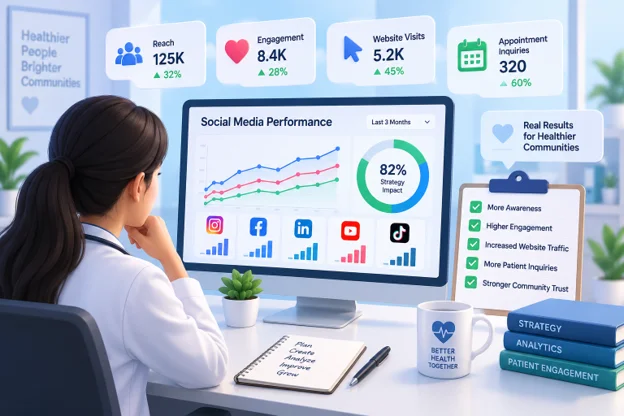
Track engagement and follower growth trends over time at both the network and individual location level, since a plateau or decline at a specific site often surfaces problems before they show up in patient volume.
Monitor review sentiment and response times across locations, since consistent, timely, compliant responses tend to correlate with stronger overall reputation over time.
Watch which types of content, provider-led education, local community posts, or general organizational updates, actually drive engagement, and adjust the shared content calendar based on what's genuinely working rather than what's easiest to produce.
Conclusion
A social media strategy for healthcare groups with multiple locations has to do more than keep everyone posting on a similar schedule. It has to balance a consistent, trustworthy brand with the compliance discipline that healthcare specifically demands, while still giving each location room to show what makes it genuinely part of its own community.
The organizations that get this right treat social media as a shared system with clear guardrails, not a task handed off separately to each location, and that structure is what ultimately protects both the brand and the patients it serves.

Frequently Asked Questions
What is the biggest difference between a healthcare social media strategy and a strategy for other industries?
The presence of protected health information. Any content involving a specific patient carries real compliance risk under HIPAA, which most other industries never have to consider when planning social content.
Can a healthcare location respond to a negative review on social media?
Yes, but the response must avoid confirming someone is a patient or referencing any details of their care. A federal enforcement case resulted in a $30,000 settlement specifically because a provider disclosed protected health information while responding to a negative review.
Should every location in a healthcare group have its own social media account?
It depends on the organization's size and structure, but every account, whether centralized or local, should follow the same brand guidelines and compliance review process regardless of who manages it day to day.
How much should content be centralized versus created locally?
A useful approach centralizes brand guidelines, compliance review, and a base content calendar, while leaving room for each location to add locally relevant content like community events or provider spotlights.
Why does patient education content perform well on healthcare social media?
Because a meaningful share of people find health information on social media hard to understand or personalize, so clear, general educational content from a credentialed source tends to stand out and build trust.
What's the safest way to involve individual providers in social media content?
Give providers clear, simple guidelines about what they can share and a straightforward review process, so their contributions stay compliant without discouraging them from participating.
How often should a healthcare group review its social media performance across locations?
On a regular, ongoing cadence rather than only when a problem surfaces, since breaking results out by location often reveals gaps that a strong network-wide average can otherwise hide.
What's the most common social media mistake multi-location healthcare groups make?
Letting individual locations manage accounts independently with no shared oversight, which tends to create both inconsistent branding and unmanaged compliance risk at the same time.