A retailer notices something odd in last quarter's traffic report. Visits are up, but the usual channels, paid search, email, and direct traffic, look almost flat. The growth is coming from somewhere analytics tools only recently learned to label clearly: AI-driven search.
That pattern is becoming the norm rather than the exception. Chatbots and AI-generated answers now sit inside the search journey for a huge share of consumers, and the traffic they send behaves differently than a typical search click. Measuring AI search visibility, and understanding what that traffic is actually worth once it arrives, has become a real analytics discipline rather than a side curiosity.
This guide covers why AI search visibility matters right now, what it actually measures, how to track it using tools built for this purpose, and how to connect that visibility to real revenue impact without guessing.
Why AI Search Visibility Matters Right Now
The shift toward AI-assisted search is no longer a niche behavior. Forty-nine percent of U.S. adults say they have used an AI chatbot, up from 33% in 2024, according to Pew Research Center. That's a substantial jump in just two years, and it signals a real change in how people start their search for information.
The habit extends beyond dedicated chatbot apps. Sixty percent of U.S. adults say they read the AI-generated summaries that now appear at the top of search results, according to Pew Research Center. For many searchers, an AI summary is the first, and sometimes only, thing they see before deciding whether to click through to a website at all.
Why can't a brand just keep tracking traditional search rankings and ignore this shift? Because a page can rank well in a traditional results list while remaining invisible inside an AI-generated answer, or the reverse. Those are two different outcomes that need two different ways of watching them.
Retailers are already seeing this play out in their own traffic data. Traffic from generative AI sources to U.S. retail websites jumped 1,200% in July 2025 compared to the same month a year earlier, according to Adobe Analytics data. Growth like that doesn't show up if a business is only watching the metrics it has always watched.
What AI Search Visibility Actually Measures
AI search visibility describes how often, and how prominently, a brand's content shows up inside AI-generated answers, chatbot responses, and AI summary panels, rather than in a traditional list of blue links. It's a distinct signal from a page's position in classic organic rankings.
This distinction matters because the two experiences pull from different mechanics. A traditional ranking reflects a single page's authority and relevance for one query. An AI-generated answer often pulls and blends information from several sources at once, then presents a synthesized response, sometimes with a citation link and sometimes without one.
Does strong traditional SEO automatically translate into strong AI search visibility? Not automatically, though the two are closely related. Good technical SEO and clear, well-structured content remain the foundation either way, but visibility inside an AI-generated answer also depends on how easily an AI system can extract and summarize a specific fact or claim from a page.
How to Measure AI Search Visibility: Step by Step
1. Use the Reporting Tools Built Specifically for AI Search
Google Search Console includes a Generative AI performance report, and Bing Webmaster Tools offers a comparable AI Performance report, according to Wikipedia's documentation of both platforms. These reports exist specifically to separate AI-driven search appearances from standard organic search data.
Start here rather than trying to infer AI visibility indirectly from general traffic reports. These tools were built for exactly this measurement problem, and they update as each platform's AI search features evolve.
2. Segment AI Referral Traffic Inside Your Analytics Platform
Most modern web analytics platforms can identify and label traffic arriving from AI chatbots and AI-powered search experiences as a distinct referral category, separate from standard organic search. Set up that segmentation early, since retroactively separating AI traffic from historical data is far harder once it's already blended together.
Once that segment exists, compare it against total organic traffic on a regular cadence. A rising share of AI-referred visits relative to total traffic is one of the clearest available signals that AI search visibility is genuinely improving.
3. Track Which Pages Get Cited or Pulled Into AI Answers
Look for patterns in which specific pages, topics, or content formats generate AI referral traffic most often. Some content naturally lends itself to being pulled into a summarized answer, particularly content that directly answers a specific, clearly framed question.
Reviewing this regularly helps identify what a brand's content is already doing well inside AI-generated answers, so that pattern can be applied more deliberately across other pages.
4. Monitor Brand and Product Mentions Inside AI-Generated Answers
Beyond referral traffic, pay attention to whether a brand gets mentioned by name inside AI-generated answers, even in cases where the AI response doesn't include a clickable link back to the site. A mention without a click still shapes how a potential customer perceives a brand before they ever visit the website.
This kind of visibility is harder to quantify with a single number, but checking how a brand's own products or services get described inside AI answers to common category questions offers a useful, if informal, gauge of overall standing.
Keep a simple running log of these checks, noting the exact question asked, the AI tool used, and how the brand was described. Repeating the same set of questions every few weeks turns an informal check into a trackable pattern instead of a one-time impression.
5. Watch Engagement Metrics for AI-Referred Visitors Specifically
Once AI referral traffic is segmented, compare engagement metrics, like time on page, pages per visit, and bounce rate, for that segment against the site's overall average. Visitors arriving from an AI-generated answer often already have a clear intent, since they've already read a summarized response before clicking through.
How to Measure the Revenue Impact of AI Search Traffic
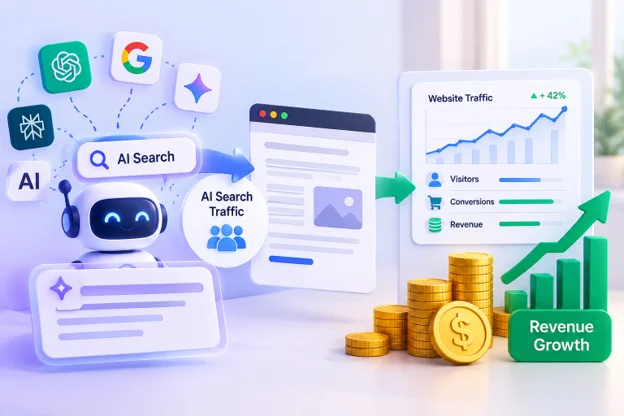
Does AI-referred traffic actually convert, or does it just add to the top of the funnel without adding real value?
The data increasingly says it converts, and often converts especially well. AI-referred traffic converted 31% more than traffic from other sources during the 2025 holiday season, and that conversion advantage nearly doubled year over year, according to Adobe Analytics data.
Revenue per visit from AI-driven traffic increased 254% year to date during that same holiday period, according to Adobe Analytics data. That's a meaningful shift from earlier data: revenue per visit from AI traffic had already increased 84% compared to non-AI sources between January and July 2025, according to Adobe's own analysis, meaning the gap has continued widening rather than leveling off.
The trend toward genuine conversion parity has been building for a while. AI-referred visitors were 43% less likely to convert than average visitors in July 2024, but that gap had narrowed to just 9% less likely by February 2025, according to Adobe Analytics data. A gap that size closing that quickly suggests AI-referred visitors are becoming a mainstream, dependable traffic source rather than a novelty.
Engagement data backs up the same conclusion. Visitors referred by generative AI sources showed 8% higher engagement, viewed 12% more pages per visit, and had a 23% lower bounce rate compared to typical visitors, according to Adobe Analytics data. Visitors arriving this way tend to already understand what they're looking for.
How should a business actually connect these percentages to its own revenue? Apply the same conversion-rate and revenue-per-visit comparisons to a company's own segmented AI traffic data, rather than assuming industry-wide percentages apply evenly. A category with naturally high consideration, like electronics, has shown stronger AI-driven conversion performance than categories like apparel or grocery, according to Adobe's analysis, so results vary meaningfully by industry.
Build a simple recurring comparison: AI-referred traffic's conversion rate and revenue per visit, measured against the same two metrics for total site traffic, tracked over the same rolling period each month. Watching that comparison trend over several months reveals whether AI search visibility is translating into real business impact, rather than judging it off any single data point.
Common Mistakes When Measuring AI Search Performance
Treating all referral traffic as one undifferentiated bucket is the most common mistake. Without separating AI-driven visits from standard organic search, a business can't tell whether a traffic increase is coming from AI search visibility improving or from an unrelated shift elsewhere.
Judging AI search visibility purely by raw traffic volume, while ignoring conversion and engagement data, is another common mistake. A smaller volume of highly engaged, higher-converting AI-referred traffic can matter more to a business than a much larger volume of traffic that never converts.
Expecting AI referral volume to grow in a straight line is a third mistake. Adobe's own data shows sharp seasonal spikes, such as the surge around Cyber Monday and the broader holiday shopping period, meaning month-to-month comparisons should account for that kind of seasonality rather than assuming steady linear growth.
Ignoring device-level differences is a fourth mistake worth avoiding. Generative AI referral traffic showed a strong preference for desktop, at 86% desktop compared to a 34% desktop share for overall traffic, according to Adobe's analysis, which means a purely mobile-first measurement approach could miss where AI-referred visitors actually convert best.
Building a Regular AI Search Measurement Routine
Set a consistent monthly review that pulls from three sources together: the AI-specific reports inside Search Console and Bing Webmaster Tools, the segmented AI referral traffic inside the main analytics platform, and a conversion and engagement comparison between AI-referred and total traffic.
Document trends over time rather than reacting to any single month's numbers. Because AI search behavior is still evolving quickly, a pattern that holds across three or four consecutive months carries far more weight than an isolated spike or dip.
Keep the routine lightweight enough to actually maintain. A short recurring checklist that gets reviewed every month consistently will tell a business far more than an elaborate measurement framework that gets built once and then quietly abandoned after the first quarter.
Share these findings with both the content and analytics teams together, since AI search visibility sits at the intersection of what content gets created and how that content's performance actually gets measured. Treating it as only a content question, or only an analytics question, tends to leave real opportunities unnoticed.
Conclusion
AI search visibility isn't a vanity metric to check occasionally out of curiosity. It's a measurable, revenue-connected signal, with dedicated reporting tools, clear segmentation methods, and a growing body of data showing that AI-referred traffic can convert as well as, or better than, traffic from more familiar channels.
The businesses that build a genuine measurement routine around it, rather than treating AI search as a passing trend, will have a much clearer picture of where their real growth is actually coming from.

Frequently Asked Questions
What does AI search visibility actually measure?
It measures how often and how prominently a brand's content appears inside AI-generated answers, chatbot responses, and AI summary panels, as distinct from a page's position in traditional organic search rankings.
What tools can I use to measure AI search visibility?
Google Search Console's Generative AI performance report and Bing Webmaster Tools' AI Performance report are both built specifically to track this kind of visibility, separate from standard search reporting.
Does AI-referred traffic actually convert into sales?
Yes, and increasingly well. AI-referred traffic converted 31% more than other traffic sources during the 2025 holiday season, according to Adobe Analytics data, and the earlier conversion gap between AI and non-AI traffic has narrowed sharply over time.
How is AI search visibility different from traditional SEO rankings?
Traditional rankings reflect a single page's position for one search query, while AI search visibility reflects how often a brand's information gets pulled into a synthesized, AI-generated answer, sometimes without a direct link back to the site.
Why does AI-referred traffic show higher engagement than average traffic?
Visitors arriving through an AI-generated answer have typically already read a summarized response before clicking through, so they tend to arrive with clearer intent, which shows up as more pages per visit and lower bounce rates.
How often should a business review its AI search performance?
A monthly review is generally enough to spot meaningful trends, since AI search behavior includes real seasonal swings, and a pattern held across several consecutive months is far more reliable than a single month's data.
Does AI search visibility vary by industry or product category?
Yes. Categories with naturally higher consideration, like electronics, have shown stronger AI-driven conversion performance than lower-consideration categories like apparel or grocery, according to Adobe's analysis.
Can a brand be mentioned in an AI answer without getting any website traffic from it?
Yes. AI-generated answers sometimes mention a brand or product by name without including a clickable link, which can still shape how a potential customer perceives that brand before ever visiting its website.