A brand manager checks category rankings on Blinkit and finds a competitor sitting at position one for a search term that used to belong to them. Nothing about the product changed. What changed is that the competitor started running ads against that search term.
That's the reality of quick commerce apps today. Organic visibility still exists, but the fastest-growing shelf space in Indian retail increasingly goes to whoever advertises for it, not just whoever stocks it first.
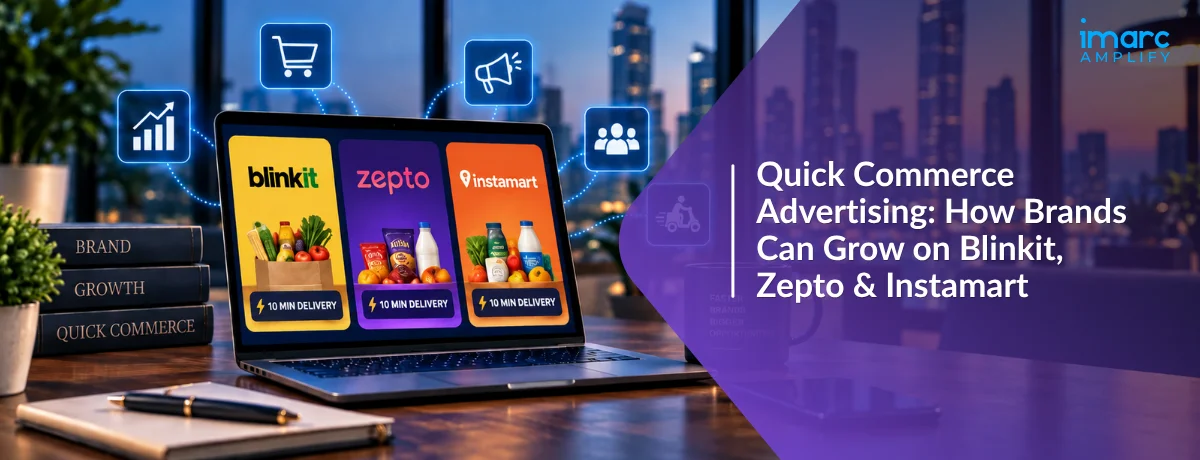
This guide breaks down how quick commerce advertising actually works across Blinkit, Zepto, and Instamart, and how brands are using it to grow inside India's fastest-expanding retail channel.
Why Quick Commerce Advertising Is Growing So Fast in India
Quick commerce's share of India's e-commerce sales jumped from 0.14% in 2018 to 4.8% in 2023, and is projected to reach 17% to 30% by 2028, according to Grant Thornton Bharat research cited by India Briefing. Its share of total retail is expected to grow from 0.3% to 2% or 3% over the same period.
The overall market has scaled just as quickly. India's quick commerce sector grew from roughly $500 million in FY 2021-22 to $3.34 billion in FY 2023-24, a 158.46% annual growth rate, according to Chryseum research cited in the same India Briefing analysis, with projections pointing toward nearly $10 billion by 2029.
That growth is concentrated among a small number of players. Market estimates cited by India Briefing put Blinkit at roughly 45% to 46% share, Swiggy Instamart around 27%, Zepto near 21%, and BB Now (BigBasket) at about 7%.
Why are brands investing so heavily in quick commerce advertising specifically? Because visibility on these apps decays fast. A 10-minute delivery window means shoppers rarely scroll far, so ranking on the first screen for a search term matters more here than on a traditional e-commerce site where browsing is more patient.
The underlying platforms are scaling to match. Zepto reported ₹9,366 crore in revenue for 2025 and had expanded to more than 250 dark stores across ten metropolitan areas by August 2024, with more than 1,000 projected by 2026, according to Wikipedia. Blinkit operated in 153 Indian cities as of March 2025, while Swiggy Instamart grew from 100 cities in March 2025 to 127 cities by July 2025, per the same source.
That expansion pace explains why advertising has become so central to how these platforms operate. More cities and more dark stores mean more search results competing for the same shopper attention, and a brand that isn't actively managing its visibility inside that expanding footprint tends to lose ground to one that is.
Zepto's scale also illustrates how quickly quick commerce has moved from a niche convenience service to a mainstream retail channel. The company employed nearly 17,000 people as of March 2026 and has attracted more than $1.5 billion in total funding since its founding in 2021, according to Wikipedia, reflecting the scale of investment now flowing into the category.
How Advertising Works Across the Big Three Quick Commerce Apps
Each platform runs its own ad system and onboarding process, and treating them as interchangeable is one of the fastest ways to waste a launch budget.
Blinkit
Blinkit operates a self-serve advertising system built around keyword-based product placement in search results, giving brands direct control over which categories and search terms they compete in.
The platform's seller tools show keyword search volume and conversion data before a brand commits to a campaign, which makes early category and keyword selection considerably less speculative than a purely trial-and-error approach.
This upfront visibility into search behavior is one of the reasons Blinkit has built the largest estimated market share among the three platforms, since brands can align their advertising decisions with actual demand patterns rather than guesswork.
Zepto
Zepto operates more like a managed vendor relationship than a fully self-serve ad platform, with campaigns typically built around homepage banners, in-feed placement, and a branded store presence coordinated directly with Zepto's category teams.
Is a managed relationship better than a self-serve system for a new brand? It depends on the brand's stage. A managed approach suits an established brand wanting broad visibility fast, while a self-serve, data-first system suits a brand still testing which keywords and categories convert.
Zepto has scaled its dark store network aggressively as part of this growth, expanding well beyond its original Mumbai base and relocating its headquarters to Bengaluru in 2024, according to Wikipedia. That expansion has been backed by significant capital, including a funding round that pushed its valuation to $5 billion in mid-2024.
For a brand, this scale means Zepto's advertising inventory keeps growing alongside its dark store footprint, which can make early relationship-building with the platform's category teams more valuable as competition for the best placements increases.
Instamart
Instamart holds a smaller overall market share than Blinkit or Zepto, trailing both in daily order volume according to market estimates cited by India Briefing, even as it continues expanding its city coverage rapidly.
Its advertising infrastructure has historically been less developed than Blinkit's self-serve system, though its position within Swiggy's broader platform gives it meaningful reach in the cities where it operates. Brands often treat it as a secondary platform to test after establishing a working model on Blinkit or Zepto first.
Instamart's rapid city expansion, growing by 27 cities in just a few months during 2025 according to Wikipedia, suggests the platform is investing heavily in closing the gap with its larger competitors, which may open up lower-competition advertising opportunities for brands willing to move early in newly added cities.
The Ad Formats Every Brand Should Understand
Across all three platforms, advertising options generally fall into three categories, each suited to a different stage of the shopper's decision.
Sponsored Product ads use keyword bidding to place a listing directly in search results, capturing shoppers who already know roughly what they want to buy.
Sponsored Brand placements show up as banners on category pages, useful for building recognition across a full product line rather than pushing a single SKU into a single search result.
Display and homepage placements, including hero banners and push notifications, cast the widest net, generally reserved for brands prioritizing broad awareness over precise targeting.
Which format should a brand test first? Sponsored Product ads almost always come first, since they target the highest-intent moment in the shopper's journey and generate the cleanest performance data to guide every format that follows.
What Brands Should Realistically Expect
Quick commerce advertising rewards brands willing to invest meaningfully during the early ranking-building phase for a new SKU, since a listing with little sales history struggles to compete against established products in the same search results.
Established products with existing brand recognition and review history generally perform better in these auctions than brand-new launches, which need time to build the sales and review signals that improve organic ranking alongside any paid support.
Should a brand trust the return metrics shown on a platform's own advertising dashboard at face value?
It's worth double-checking. Return calculations can look more favorable when measured against list price rather than the actual discounted price a shopper pays, so brands should recalculate returns using real selling price before judging a campaign's performance.
Patience matters more in this category than in slower-moving retail channels. Given how quickly quick commerce platforms are adding cities and dark stores, a brand's competitive position on any single platform can shift within a matter of months, not years, making regular review of advertising strategy far more important than a set-and-forget approach.
A Quick Example: Two Brands Launching on Quick Commerce
One brand launches on all three platforms simultaneously with an identical, evenly split approach, assuming quick commerce advertising works the same way everywhere. Results are inconsistent, and the brand can't tell which platform's audience actually wants the product.
A second brand in a similar category starts on Blinkit alone, using the platform's pre-campaign keyword data to identify its two or three most competitive search terms before launching.
The second brand builds a clear picture of what's actually working within a month, then expands to Zepto and Instamart with an approach informed by real results, rather than a strategy split evenly across three unfamiliar systems.
Both brands invest a similar amount of effort over the quarter. Only the second one can explain exactly why its advertising is or isn't working on each platform.
Common Mistakes Brands Make With Quick Commerce Advertising
A handful of recurring habits undercut results for brands entering quick commerce advertising for the first time.
Treating all three platforms as identical: Blinkit's self-serve, data-transparent model and Zepto's managed relationship approach call for genuinely different strategies, not one campaign copied across both.
Trusting dashboard return metrics without adjusting for list price: A return figure built on list price rather than actual selling price can look considerably stronger than the real, profit-adjusted outcome.
Pulling back too early during the ranking-building phase: Cutting support before a new SKU has built enough sales history to rank organically often stalls momentum right before it would have paid off.
Ignoring regional platform strength when choosing where to focus: A brand strong in South India that spends evenly across all three platforms is underweighting the platform where its existing customer base is most concentrated.
Skipping available keyword and conversion data before launching: Blinkit specifically provides this data upfront, and brands that skip reviewing it are essentially guessing at category competitiveness.
How to Measure Whether Quick Commerce Advertising Is Working
Recalculate returns against real selling price rather than list price before judging any campaign's performance, since the two can tell very different stories about actual profitability.
Review search ranking movement for target keywords regularly, since competitive categories can shift meaningfully within a single quarter as more brands enter the same search terms.
Compare organic ranking movement alongside paid support. A SKU that climbs organically after a period of paid support justifies tapering that support, while one that only ranks while ads are active needs continued investment or a pricing and positioning review.
Watch platform-specific performance separately rather than blending all three into one number, since Blinkit, Zepto, and Instamart audiences can respond very differently to the same product.
Conclusion
Quick commerce advertising has moved from an experimental add-on to a core part of growth strategy for brands serious about urban India, and the platforms reward brands that treat each one as its own distinct system rather than a single unified channel.
Start with the platform where a brand's existing distribution and regional strength already align, use available keyword and conversion data before launching, and expand only once real, profit-adjusted results justify the next platform.
With quick commerce's share of Indian retail still projected to grow substantially through 2028, the brands building disciplined, platform-specific strategies now are the ones best positioned as the category matures.

Frequently Asked Questions
What is quick commerce advertising?
It's the paid visibility system used on quick commerce apps like Blinkit, Zepto, and Instamart, including sponsored product listings, category banners, and homepage placements that determine which products shoppers see first.
Which quick commerce app should a brand start advertising on first?
It depends on regional strength and preferred approach. Blinkit's self-serve, data-transparent system suits brands still testing what works, while Zepto's managed relationship model suits brands ready for broader, coordinated visibility.
How is Zepto's advertising approach different from Blinkit's?
Zepto typically works through a managed relationship with its category teams, while Blinkit offers a more self-serve system with upfront keyword and conversion data available before a brand commits to a campaign.
What share of India's e-commerce market does quick commerce represent?
Quick commerce grew from 0.14% of e-commerce sales in 2018 to 4.8% in 2023, and is projected to reach 17% to 30% by 2028, according to Grant Thornton Bharat research.
Which platform currently leads India's quick commerce market?
Blinkit holds the largest estimated market share at roughly 45% to 46%, ahead of Swiggy Instamart at around 27% and Zepto at approximately 21%.
Why might a platform's own ROAS dashboard overstate real returns?
Return figures can be calculated against list price rather than the actual discounted price a shopper pays, which can make performance look stronger than the real, profit-adjusted result.
Is Instamart worth advertising on compared to Blinkit and Zepto?
It depends on regional fit. Instamart trails the other two in overall market share, but its reach in the cities where it's strong can still make it worthwhile for brands with aligned regional distribution.
How fast is the quick commerce market expected to keep growing?
India's quick commerce sector grew at roughly 73% annually between FY 2021-22 and FY 2023-24, according to Chryseum research, with continued strong growth projected through 2029.