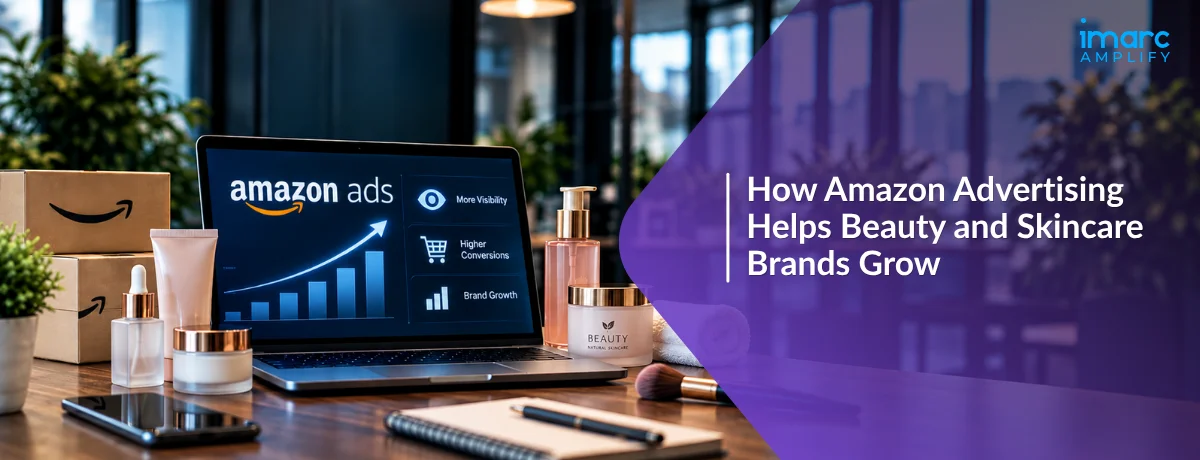
A shopper searches "vitamin C serum" on Amazon and scrolls past dozens of near-identical bottles before picking one. That decision often comes down to which brand paid to be seen first, not which formula is objectively better.
That's the reality beauty and skincare brands compete in on Amazon today. The category grew 13% year-over-year in Q1 2026, reaching $8.1 billion in revenue and outpacing both CPG and vitamins, according to Front Row Group. More brands are chasing that growth, which means visibility has to be earned or bought.
Amazon Advertising for beauty and skincare brands isn't optional anymore. It's the mechanism that decides which products actually get found inside a marketplace where organic ranking alone rarely cuts through.
Why This Category Rewards Advertising So Heavily
Skincare drives most of that growth, making up 34% of the beauty market and climbing 18% year-to-date to $2.7 billion in Q1 2026 alone. Makeup grew at the same 18% rate, while hair care rose 10% to $2.4 billion.
Search behavior inside the category is shifting fast too. Terms like "peptide" jumped 1,717% year-over-year, and "copper peptides" spiked more than 36,000%, per Front Row Group's 2026 snapshot. New ingredient trends create new search demand almost overnight.
That volatility is exactly why paid visibility matters. Organic rankings take weeks or months to catch up to a trending ingredient search. A well-targeted Sponsored Products campaign can appear against that search the same day it starts trending.
Brand spend on Amazon advertising in the beauty category rose 7.8% year-over-year, and cost-per-click climbed 4.5% to $1.39, the fifth-highest CPC among Amazon's top 15 categories, according to Pacvue's Q1 2026 report. Competition is intensifying, which raises the cost of staying visible.
K-beauty is accelerating that competition further. Medicube posted $108 million in estimated Amazon sales in Q1 2026, up 217% year-over-year, signaling that Korean skincare brands are no longer a niche import but a mainstream force bidding for the same search terms as legacy names like L'Oréal Paris and CeraVe.
Fragrance is the outlier, growing just 3% overall, though niche formats like children's and solid perfumes posted triple-digit gains. That unevenness matters for advertising strategy, since a flat category average can hide fast-moving subsegments worth targeting specifically.
What Amazon Advertising Actually Does for a Beauty Brand
Three ad types cover most of what a beauty brand needs, and each solves a different problem in the customer's path to purchase.
Sponsored Products place a listing directly in search results and on competitor product pages, capturing shoppers who already know roughly what they want. This is where most beauty ad budgets should start, since it targets the highest-intent moment in the search.
Sponsored Brands showcase a logo, headline, and multiple products together, which works well for beauty brands trying to build recognition across a full skincare routine or makeup line rather than a single SKU.
Sponsored Display and Amazon DSP handle retargeting and audience expansion outside the search results page, reaching shoppers who viewed a product but didn't buy, or who fit a lookalike audience based on past purchase behavior.
Which ad type should a new beauty brand start with?
Sponsored Products, because it targets shoppers actively searching for a product like yours, giving new listings the fastest path to their first reviews and sales velocity.
The Amazon Influencer Program and Brand Stores can complement paid advertising, helping brands build product discovery and reinforce trust beyond individual ad placements. Posts let a brand show lifestyle imagery inside the shopping feed, while influencer-driven storefronts build the kind of trust that makes a paid click convert once a shopper lands on the page.
Reviews and ratings velocity also compound advertising performance in ways brands often overlook. A listing with strong Sponsored Products traffic but few reviews converts worse than a similar listing with dozens of recent, relevant reviews, since beauty shoppers rely heavily on social proof before trusting a formula on their skin.
The Numbers Beauty Brands Should Actually Expect
Beauty and personal care benchmarks run more favorably than most Amazon categories. Cost-per-click typically falls between $0.90 and $1.50, click-through rate sits around 0.4% to 0.7%, and conversion rate often reaches 12% to 18%, well above categories like electronics or apparel.
That higher conversion rate reflects genuine repeat-purchase behavior. Someone who already trusts a moisturizer or serum brand converts quickly when that same brand shows up again in a related search.
ACOS, the ratio of ad spend to sales it generates, typically runs 20% to 30% for beauty products with healthy margins, though newer or lower-margin lines may need to accept a higher number early on to build sales history and reviews.
Those healthy benchmarks come with a catch. ROAS improvement across the category lagged at just 1.6% year-over-year even as spend rose 7.8%, according to Pacvue, meaning brands are paying more without seeing proportionally better returns unless they actively optimize targeting.
How Branded Search Is Reshaping the Advertising Opportunity
One in five beauty purchases during Prime Day 2026 started with a shopper searching a brand name directly, up from 17.4% the year before, according to a Market Defense Report covered by PR Newswire. Medicube became the top branded search term in skincare, pulling 1.99 million monthly searches, a 47.6% jump year-over-year.
That shift changes the advertising calculus. Brands with strong name recognition can defend that branded search term relatively cheaply, while newer brands face steeper costs trying to interrupt shoppers already searching for a competitor by name.
Beauty search volume overall jumped 71% during Prime Day week, from 102.4 million to 174.8 million searches, yet click-through rates actually fell from 34.7% to 30.4%. Shoppers arrived already knowing what they wanted, browsing less and buying faster once they found it.
Does that mean discovery advertising still matters if shoppers already know what they want?
Yes, but the target shifts. Discovery campaigns should focus on capturing shoppers before they form brand loyalty, not competing for attention after they've already decided.
Retargeting and DSP: Where the Real Efficiency Gains Show Up
A Korean beauty brand expanding into new markets used Amazon DSP's Performance+ tool, which applies AI targeting seeded by first-party audience data, and saw a 97% uplift in ROAS alongside a 55% reduction in cost per acquisition, according to Amazon Ads' own case study.
That brand's approach had two phases. First, it placed an Amazon ad tag on its own website to capture visitor behavior and build a remarketing audience. Second, it layered Performance+ on top to find new, high-conversion-potential shoppers using that same audience data as a seed.
Is DSP worth the added complexity for a smaller beauty brand?
It can be, once Sponsored Products campaigns are already converting well. DSP performs best when there's existing purchase and browsing data to retarget against, rather than as a first advertising move.
Frequency capping also matters more in beauty than most categories, since skincare and makeup purchases often involve research across multiple sessions. The Korean brand case study increased ad frequency during peak periods like Black Friday and pulled back afterward, protecting ROAS instead of overspending on shoppers who'd already converted.
Common Mistakes Beauty Brands Make With Amazon Advertising
A few recurring habits quietly drain ad budgets across the category, even for otherwise strong products.
Bidding on broad, generic terms instead of ingredient-specific ones: A campaign built around "moisturizer" competes against thousands of listings, while "ceramide moisturizer for dry skin" reaches a much more qualified, lower-competition audience.
Ignoring branded defense campaigns: Competitors frequently bid on rival brand names, and skipping a defensive Sponsored Products campaign on your own name cedes that traffic for the cost of a single ad slot.
Launching DSP before Sponsored Products has enough data: Retargeting a small or thin audience produces weak results, so DSP should follow, not precede, a proven Sponsored Products foundation.
Treating rising CPCs as a reason to pause spend entirely: Pausing during a CPC spike often means losing search position right as a trending ingredient search starts, which usually costs more in lost momentum than the higher click price does.
Not adjusting bids around trending search spikes: Ingredient searches like "peptide" or "copper peptide" can jump thousands of percent almost overnight, and static bids miss that entire window of demand.
Running ads against a listing with weak reviews or thin content: Sending paid traffic to a page that hasn't earned trust yet wastes spend on clicks that were never going to convert, no matter how well-targeted the keyword was.
Underinvesting around major shopping events: Some beauty category cost-per-click rates hit $60 during Prime Day 2026 bidding wars, and brands that pulled back entirely rather than adjusting strategy lost visibility during the highest-intent shopping window of the year.
Measuring Whether the Ad Spend Is Actually Working
TACOS, total advertising cost of sale, matters more than ACOS alone for an established beauty brand, since it accounts for organic sales alongside advertised ones rather than judging campaigns in isolation.
Track new-to-brand customer percentage on Sponsored Brands and DSP campaigns specifically. A campaign that only reaches existing customers isn't growing the brand, even if its ACOS looks efficient on paper.
Watch conversion rate by keyword type separately from overall account conversion rate. Ingredient-specific and branded terms typically convert well above category averages, and blending them into one number hides which campaigns are actually earning their spend.
Review search term reports monthly, not quarterly, given how fast beauty search trends move. A keyword that wasn't worth bidding on last quarter can become genuinely valuable within a few weeks if a related ingredient starts trending.
Off-Amazon traffic deserves its own line in that review too. Brands that drove external marketing into their Amazon listings during Prime Day 2026 saw returns of 7 to 10 times ad spend on that traffic alone, according to the Market Defense Report, showing that Amazon advertising performance isn't purely an on-platform story.
AI-referred traffic is worth tracking separately as well. That traffic surged 89% year-over-year during Prime Day week and converted 40% better than email or paid search, suggesting brands should treat AI-driven discovery as a growing, distinct channel rather than folding it into general search performance.
A Quick Comparison: Two Skincare Brands, Two Different Approaches
One skincare brand relies almost entirely on broad Sponsored Products campaigns targeting generic category terms, accepting whatever ACOS results and rarely adjusting bids. Ad spend keeps climbing along with the category's rising CPCs, but sales growth stays flat.
A second brand in the same category builds ingredient-specific and branded-defense campaigns, layers in DSP retargeting once Sponsored Products data matures, and reviews search term reports every few weeks to catch trending terms early.
Both brands operate in a category where CPCs rose 4.5% year-over-year. Only the second brand's structure lets it absorb that cost increase without losing ground, because its campaigns are built around actual search intent rather than broad category presence.
Conclusion
Amazon Advertising for beauty and skincare brands works best as a layered system: Sponsored Products for high-intent search, Sponsored Brands for routine-level recognition, and DSP for retargeting once enough purchase data exists to make it worthwhile.
The category's favorable conversion rates make this investment pay off faster than in most other Amazon categories, but only for brands willing to track search trends closely and adjust campaigns as ingredient searches and branded search behavior keep shifting.
Beauty and skincare shoppers are already searching, comparing, and buying at scale on Amazon. Advertising decides which brands they actually find in that process.

Frequently Asked Questions
How much should a beauty brand budget for Amazon Advertising?
There's no universal number, but tracking ACOS against your actual margin, typically targeting 20% to 30% for beauty, gives a realistic ceiling for sustainable ad spend as sales volume grows.
What's the difference between ACOS and TACOS for a skincare brand?
ACOS measures ad spend against advertised sales only, while TACOS measures total ad spend against all sales, including organic. TACOS gives a clearer picture of overall advertising efficiency as a brand matures.
Can a new skincare brand compete with established Amazon beauty brands on advertising?
Yes, especially by targeting specific ingredient searches and long-tail keywords where larger brands aren't bidding aggressively, rather than competing head-on for broad, expensive category terms.
Is Amazon DSP necessary for a small beauty brand?
Not immediately. DSP performs best once Sponsored Products campaigns have generated enough purchase and browsing data to build effective retargeting and lookalike audiences.
Why did click-through rates drop even though beauty search volume rose sharply?
Shoppers increasingly arrive already knowing which product or brand they want, so they click faster and browse less, which lowers click-through rate even as overall search volume climbs.
Should beauty brands pause advertising when CPCs spike?
Usually not. Pausing during a CPC spike often means losing search visibility exactly when a trending ingredient or seasonal demand is driving the most purchase intent.
How often should beauty brands review their Amazon search term reports?
Monthly at minimum, and more often during periods of rapid ingredient trend growth, since beauty search behavior shifts faster than most other Amazon categories.
Does branded search really matter for smaller, less recognizable beauty brands?
It matters less initially, but running a small defensive Sponsored Products campaign on your own brand name still protects against competitors bidding on it as recognition grows over time.