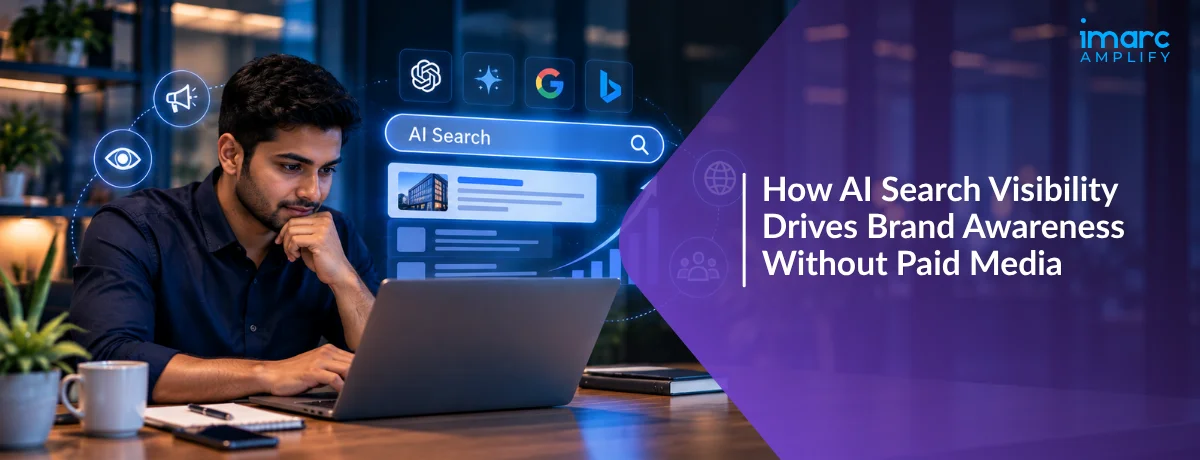
A prospective customer asks ChatGPT for the best project management tool for a small team. Three names come back. No ad ran, no click happened, yet one of those three brands just won a sliver of trust that a banner ad could never buy.
That's the quiet shift happening across marketing right now. AI search visibility, being named inside AI-generated answers, is starting to do the awareness-building work that paid media used to own almost exclusively.
This article looks at why that's happening, what actually makes a brand show up in these answers, and how to build a real AI search visibility strategy around it.
What AI Search Visibility Actually Means
AI search visibility is how often, and how favorably, a brand appears inside answers from tools like ChatGPT, Perplexity, Gemini, and Google AI Overviews. It has nothing to do with ranking on a results page, since there often isn't one to rank on.
This differs from a click-based channel in a fundamental way. A paid ad or a ranked link needs a click to deliver any value. An AI mention delivers value the moment it's read, whether or not the person ever visits a website afterward.
That single difference is why AI search visibility strategy looks so different from a typical paid media plan. The goal isn't traffic. It's being part of the answer itself.
Why This Builds Brand Awareness Even Without a Click
Zero-click behavior has become the norm, not the exception. Around 65% of informational queries now resolve without the user ever visiting a website, according to recent search data. People get their answer and move on.
That doesn't mean nothing happened. Nearly a third of consumers now trust AI summaries roughly as much as they trust a brand's own website, and 58% of Gen Z users believe AI recommendations are objective. Being named in that summary functions a lot like being mentioned by a trusted friend.
Researchers have started calling this effect "decision compression." Instead of comparing ten options across multiple searches, a buyer now gets three to five names handed to them in one response. Making that shortlist matters enormously, even if the person doesn't click anything for another two weeks.
Decision speed backs this up. About 48% of consumers using AI search tools report making faster purchase decisions than they did researching the old way. Whichever brand got mentioned early had far more influence over that faster decision than anything the shopper found later on their own.
AI search traffic itself has grown fast too, up roughly 527% year over year, with tools like Perplexity reporting 300% growth in query volume and ChatGPT crossing 180 million monthly active users. Even a small percentage of that volume touching your brand adds up to meaningful exposure over time.
The Mechanics: How Brands End Up Inside AI Answers
AI models don't rank pages the way search engines do. They synthesize an answer from patterns across the web, which means the inputs that matter are different too.
Brand mentions across the broader web correlate with AI visibility far more strongly than backlinks do, by a wide margin. One analysis found a 0.664 correlation between web mentions and AI visibility, compared to just 0.218 for traditional backlinks. Getting talked about matters more than getting linked to.
This has a compounding effect. Brands in the top 25% for web mentions receive roughly 10 times more AI citations than the next tier down. Visibility snowballs once a brand reaches a certain density of mentions across articles, forums, comparison sites, and review platforms.
Consistency also matters. When a brand gets described differently across different sources, name variations, outdated details, conflicting facts, AI models have a harder time confidently citing it as a reliable answer. A clean, consistent presence across the web functions almost like a trust signal.
Think of it less like optimizing a webpage and more like managing a reputation that lives across thousands of pages you don't control. The brand that shows up in an AI answer usually earned that spot through years of being discussed accurately, not through a single optimization project.
AI Search Visibility vs. Paid Media: A Direct Comparison
These two channels aren't really competing for the same job, but comparing them side by side shows why visibility deserves real budget and attention.
| Factor | Paid Media | AI Search Visibility |
|---|---|---|
| Cost per impression | Ongoing, scales with spend | No direct cost per mention |
| Decay when spend stops | Immediate | Persists as long as web presence holds |
| Trust perception | Known to be paid | Perceived as more neutral |
| Scalability | Limited by budget | Limited by actual reputation and mentions |
| Measurement | Direct, real-time | Indirect, requires new tracking methods |
Paid media still wins on speed and control. AI search visibility wins on durability and trust, since a citation earned through genuine reputation doesn't disappear the moment a budget gets cut.
Conversion data backs up the trust angle too. Visitors who do click through from AI tools like ChatGPT convert at around 15.9%, compared to roughly 1.76% for typical organic search traffic. The people who do act on an AI recommendation tend to act on it seriously.
That gap makes sense once you consider what's happening upstream. An AI mention already did the filtering work a top-of-funnel ad usually handles. By the time someone clicks through from an AI answer, they've effectively pre-qualified themselves as seriously interested.
Building an AI Search Visibility Strategy
A real strategy here looks less like traditional content marketing and more like reputation management spread across the entire web, not just your own site.
Get mentioned beyond your own domain. Since web mentions correlate with visibility far more than backlinks, prioritize being discussed accurately on comparison sites, industry publications, forums like Reddit, and review platforms. This often means actively participating in relevant communities rather than only publishing on your own blog.
Keep brand facts consistent everywhere. Audit how your company name, founding details, product descriptions, and pricing appear across the web. Inconsistencies quietly undermine how confidently AI models cite you. Outdated directory listings and old press mentions are common, overlooked culprits worth cleaning up first.
Structure your own content to be quoted. Clear, direct definitions and specific claims get lifted into AI answers far more easily than vague marketing language. Write the sentence you'd want an AI model to repeat verbatim.
A Quick Example of the Effect in Practice
Consider two competing software companies with similar products and similar ad budgets. One spends heavily on search ads and social campaigns. The other invests time in getting accurately discussed across review sites, comparison articles, and niche communities.
Six months later, someone asks an AI assistant to recommend a tool in that category. The company with heavy ad spend but thin independent web presence may not appear at all, since ads don't feed AI training or retrieval the way genuine mentions do. The company with strong, consistent third-party visibility shows up by name, unprompted, in front of someone who never saw a single one of its ads.
That's the asymmetry driving so much current interest in AI search visibility strategy. Ad spend and AI visibility aren't the same lever, and treating them as interchangeable misses where actual influence is shifting.
How to Know If It's Working
Traditional analytics weren't built to measure a channel where the value happens before any click occurs. A few workarounds fill that gap.
Track branded search volume over time. Rising searches for your company name specifically often reflect growing AI-driven awareness, even without directly attributable traffic. Use AI visibility tracking tools that run sample queries and log which brands appear, giving a rough share-of-voice figure against competitors.
Watch direct traffic and time-to-conversion trends too. Buyers who already encountered your brand in an AI answer often skip research steps and go straight to your site by name, which shows up as direct traffic rather than a referral.
Sales conversations offer another useful signal. If prospects increasingly mention "I asked ChatGPT" or "an AI tool recommended you" during calls, that qualitative feedback confirms the channel is working even before it shows up cleanly in a dashboard.
Common Misconceptions About AI Search Visibility
A few assumptions lead brands to underinvest here or approach it the wrong way.
“If there's no click, there's no value.” Awareness and trust can build well before any measurable click, the same way billboard or podcast advertising works.
“This is just SEO with a new name.” Traditional SEO optimizes for rankings and clicks. AI search visibility optimizes for being part of the answer itself, which relies more on reputation across the web than technical page optimization.
“Backlinks are still the main lever.” Broader web mentions now matter more than backlinks specifically for AI citation likelihood, which changes where effort should go.
“This only matters for tech companies.” Any brand where buyers research before purchasing, from software to healthcare to home services, can benefit from showing up accurately in AI-generated comparisons.
“It's too early to bother with this.” Given how quickly AI query volume has grown, waiting means competitors have more time to accumulate the mentions and reputation that make citation more likely later.
Conclusion
AI search visibility works because it meets buyers at the exact moment they're forming an opinion, often before they've clicked on anything at all. That's a fundamentally different kind of awareness than a paid impression buys.
Building a real AI search visibility strategy means shifting focus from your own website to your reputation across the entire web. Get mentioned accurately, get mentioned often, and the awareness builds itself into every AI answer that matters to your buyers.
None of this replaces paid media outright, and it shouldn't try to. It adds a durable layer of awareness that keeps compounding quietly in the background, long after any single campaign has ended.

Frequently Asked Questions
1. What is AI search visibility?
AI search visibility is how often and how accurately a brand gets mentioned inside answers generated by tools like ChatGPT, Perplexity, Gemini, and Google AI Overviews, regardless of whether a click follows.
2. How is AI search visibility different from SEO?
SEO optimizes for ranking on a results page and earning clicks. AI search visibility optimizes for being included directly inside a generated answer, which depends more on web-wide reputation than on-page technical factors.
3. Can AI search visibility really replace paid media?
Not entirely. Paid media still offers speed and control that organic visibility can't match. Most effective strategies use both, with AI visibility building durable, trust-based awareness that doesn't disappear when ad spend stops.
4. Do backlinks still matter for AI search visibility?
Yes, but less than broader web mentions. Research shows web mentions correlate far more strongly with AI visibility than backlinks alone, so reputation across many sources matters more than link volume.
5. How can I measure AI search visibility if there's no click to track?
Track branded search volume, direct traffic trends, and use AI visibility tracking tools that sample queries to see how often your brand appears compared to competitors.
6. Does AI search visibility work for small businesses?
Yes, though it takes consistent, accurate mentions across relevant sites rather than large ad budgets. Smaller brands with strong niche reputations can appear in AI answers just as easily as larger competitors.
7. What's the biggest factor in getting cited by AI tools?
Consistent, accurate brand mentions across the broader web, not just your own site, correlate most strongly with AI citation frequency, more than backlinks or on-page SEO alone.
8. How long does it take to build meaningful AI search visibility?
It varies, but since it depends on accumulated web mentions and reputation, most brands see gradual improvement over several months rather than an immediate shift.