You have a fixed marketing budget, a product that works, and a board asking where the pipeline is going to come from.
Two options sit in front of you. One is SEO - publishing content and improving your website so buyers find you on Google without you paying for the click. The other is performance marketing - paying for ads so your product appears in front of buyers today.
Most early-stage teams cannot afford to do both properly in the first six months. So SEO vs Performance Marketing stops being a theoretical debate and becomes a real budget decision with real consequences for your runway.
This blog walks you through what each channel costs, how fast each one works, and what kind of leads each one brings, so you can decide which deserves the first slice of your budget.
What Is SEO?
SEO, or search engine optimisation, is the work you do to make your website appear in Google's free search results.
When an operations head types "inventory software for small manufacturers" into Google, everything below the ads is organic. SEO is how you earn a spot there.
In practice it comes down to three things:
- Content - writing pages that answer the questions your buyers actually search for
- Technical health - making sure your site loads fast and Google can read it properly
- Credibility - earning links and mentions from websites Google already trusts
You do not pay Google for these clicks. You pay for the people, time, and tools needed to create the content, and then you wait for it to rank.
The simplest way to think about it: you are building an asset. Once a page ranks, it can bring in leads month after month without extra spend.
What Is Performance Marketing?
Performance marketing is paid advertising where you spend against a measurable result - a click, a form fill, or a booked demo.
You set a budget, choose exactly who should see the ad, and traffic starts arriving the same day. For B2B, the main channels are Google Search ads, LinkedIn ads, and retargeting ads that follow visitors around the web.
The biggest advantage is control. On LinkedIn you can show an ad only to operations heads at manufacturing companies with 200 to 1,000 employees. No other channel lets you be that precise, that fast.
The catch is just as simple. The moment you stop paying, the traffic stops. You are renting attention rather than owning it.
Cost Comparison: Upfront Spend vs Long-Term Investment
Both channels cost money. They just cost it in very different shapes.
SEO costs more at the start relative to what you get back. You pay a writer, a specialist, and some tools for several months before meaningful traffic arrives. But the cost per lead keeps falling, because the same page keeps working long after you have paid for it.
Performance marketing is steadier and easier to predict. You can start small and scale up. But your cost per lead rarely improves dramatically, and in competitive B2B categories ad costs usually rise as more companies bid on the same keywords.
There is no cheap option here. There is only the question of whether you want to pay more now and less later, or the same amount every month indefinitely.
A useful way to picture it:
- SEO is like buying a machine. Expensive upfront, cheaper per unit later.
Performance marketing is like renting one. Low commitment, but the bill never stops.
Speed to Results: How Fast Will Something Happen?
This is where the two channels are least alike.
Performance marketing shows you something within days. You launch on Monday and by Friday you know your click cost, which headline works, and whether anyone is filling the form. That feedback loop is genuinely valuable when you are still figuring out your message.
SEO usually takes three to six months before rankings and traffic build up, and closer to six to twelve months before results become reliable and repeatable. Very little happens in months one and two, which is exactly when nervous founders tend to pull the plug.
If you need proof of traction for a fundraise in ninety days, that timeline matters more than any other factor on this page.
Lead Quality: Who Actually Shows Up
Speed is not the same as quality, and this is where SEO quietly wins.
Someone who found you by searching "how to reduce warehouse picking errors" has a problem and is looking for a fix. They arrived on their own. That intent tends to produce better conversations and shorter sales cycles.
Ad traffic is different. You chose them; they did not choose you. The intent varies depending on how well you targeted, and B2B buyers are naturally more sceptical of something labelled as an ad. Follow-up has to work harder.
That said, paid gives you something organic cannot: precision. If you sell only to CFOs at insurance firms, you can reach exactly those people next week instead of hoping they search for you.
The practical takeaway is that organic tends to bring fewer leads that convert better, while paid brings more leads that need more work. Neither is automatically the better trade.
|
What you are comparing |
SEO |
Performance Marketing |
|
COST |
||
|
Upfront spend |
Low to moderate - content, tools, and specialist time |
Can start small, but you need an ad budget every single day |
|
Cost per lead over time |
Drops steadily as content and rankings build up |
Stays flat or rises as competition increases |
|
If you stop paying |
Traffic and leads continue for months, sometimes longer |
Traffic and leads stop almost immediately |
|
SPEED |
||
|
Time to first results |
Usually 3-6 months before rankings and traffic build |
Within days of launching a campaign |
|
Time to reliable results |
6-12 months |
2-4 weeks, after initial testing |
|
LEAD QUALITY |
||
|
Buyer intent |
High - people actively searched for a solution |
Varies - depends entirely on targeting quality |
|
Trust level |
Higher - organic results feel more credible to B2B buyers |
Lower initially - seen as an ad, needs stronger follow-up |
|
Volume control |
Hard to control precisely, it grows gradually |
Easy to scale up or down with budget |
When Should a B2B Startup Choose SEO First?
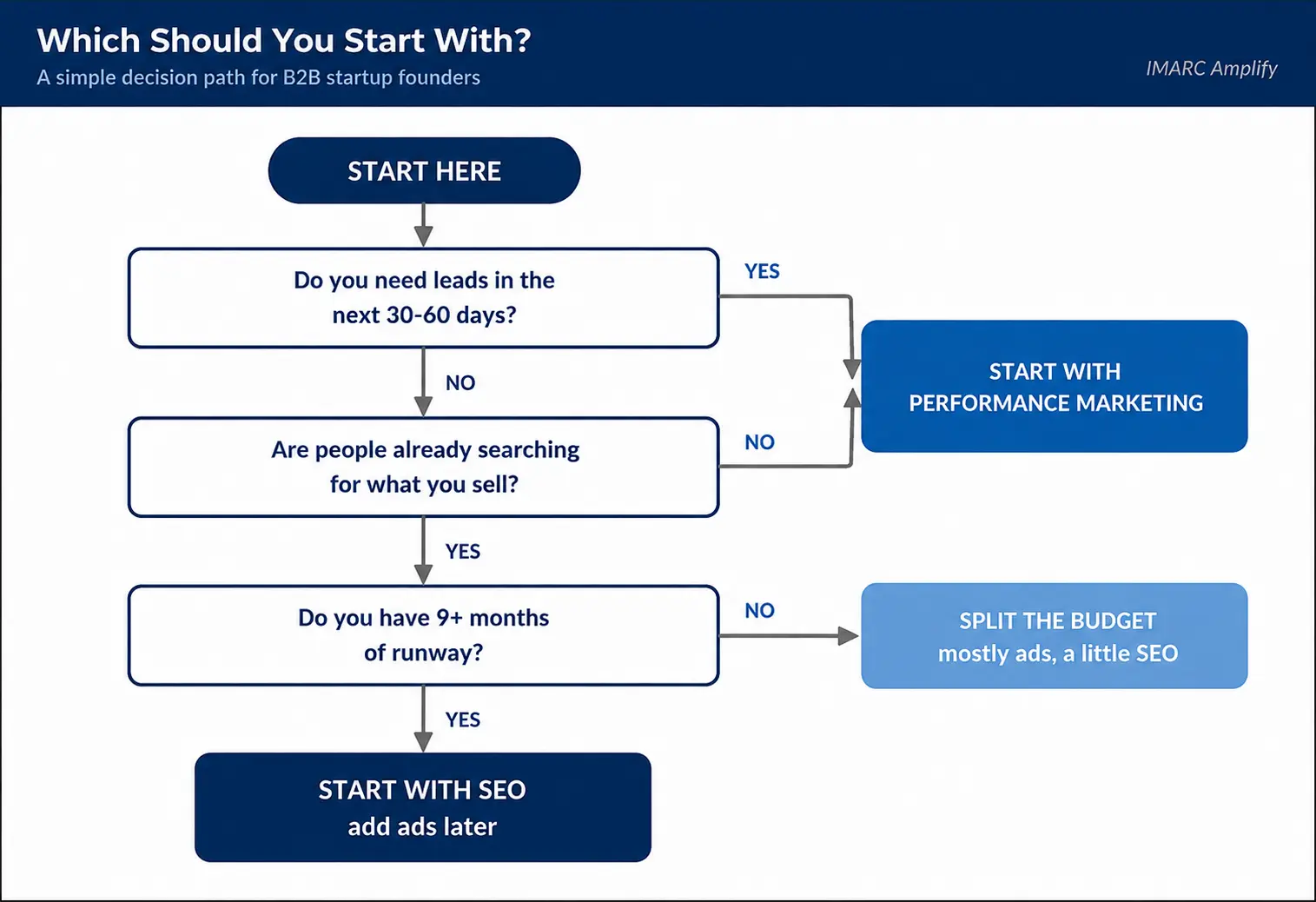
Start with SEO if most of these describe you:
- You have at least nine to twelve months of runway and no immediate pressure to show leads
- People are already searching for the problem you solve, so demand exists and you just need to capture it
- Your average deal size is modest, which makes a high cost per lead hard to justify
- Someone on your team can write credibly about your industry, or you have budget for a specialist who can
- Your sales team is small and a sudden spike in leads would overwhelm them
- Your buyers research heavily before ever speaking to a salesperson
In short, SEO first suits companies with time, existing search demand, and tight unit economics.
When Should a B2B Startup Choose Performance Marketing First?
Start with ads if most of these describe you:
- You need leads in the next thirty to sixty days
- Your category is new and almost nobody is searching for it yet, so there is nothing to rank for
- Your deal size is large enough to absorb a cost per lead in the hundreds
- You are still testing your messaging and need fast feedback on what resonates
- You are selling to a narrow, well-defined audience you can target by job title or company
- You have a fundraise or board review coming up and need traction data quickly
In short, ads first suit companies with urgency, high deal values, or a market that does not know it needs them yet.
Why B2B Startups Usually Need Both Eventually
For most founders weighing SEO vs performance marketing for B2B startups, the honest long-term answer is that these two are partners rather than rivals. Whichever you start with, the other tends to become necessary within a year. Here is how they help each other.
Ads tell you what to write about. Within a few weeks of running campaigns you know which headlines, pain points, and offers convert. That is a free content brief for your SEO team, based on real buyer behaviour rather than guesswork.
SEO brings your blended cost down. As organic traffic grows, you need fewer paid clicks to hit the same pipeline number, which frees budget for testing new channels.
Retargeting catches the visitors organic brings in. Most people who read your blog will not fill a form on the first visit. A small retargeting budget keeps you visible while they think it over.
And buyers trust you more when they see both. Appearing in search results and in a LinkedIn feed signals a company that is established, not experimental.
Your Decision Checklist
You do not need a consultant to settle this. Run through these six questions with your team and the answers will point clearly in one direction.
- How many months of runway do we have before we must show pipeline?
- Are buyers already searching for our category, or do we have to create demand?
- Can our deal size absorb a lead that costs several hundred dollars?
- Can our website actually convert traffic if we send it there tomorrow?
- Do we have anyone who can produce credible content about our industry?
- What happens to our pipeline if we pause ad spend for a month?
If your answers cluster around long runway and existing search demand, start with SEO. If they cluster around urgency, high deal value, or a brand-new category, start with ads. If you can afford a modest budget for each, run both and let three months of data decide the split.
The Bottom Line
There is no universally correct answer to SEO vs Performance Marketing - only the answer that fits your runway, your deal size, and how urgently you need pipeline. Ads buy you speed and information; SEO buys you a cost base that improves every year.
Start with the one your situation demands, and plan to add the other within twelve months.
Not sure which side your business falls on? Our team can look at your category, deal size, and runway and give you a straight recommendation.

Frequently Asked Questions
1. How much should a B2B startup spend on each channel?
Most early-stage teams start with roughly 70 to 80 percent of budget on ads and the remainder on organic foundations. As content starts ranking, that split moves closer to even, usually somewhere between months twelve and eighteen.
2. Can we do SEO without hiring a full-time specialist?
Yes, at the start. A founder who knows the industry plus a freelance writer and a technical audit can cover the first six months. Bring in a specialist once you are publishing regularly and need to scale properly.
3. How long before we should judge whether SEO is working?
Give it six months minimum. Look for rising impressions and keyword positions in months two to four, then actual traffic and leads from month five onward. Cancelling at month three is the most common and most expensive mistake.
4. Are LinkedIn ads worth it for a small startup budget?
They can be, if your deal size supports it. LinkedIn clicks cost far more than Google clicks, so it works best when one closed customer is worth thousands. For smaller deal sizes, Google Search ads usually stretch the budget further.
5. Does SEO still matter now that buyers ask AI tools for recommendations?
It matters more than before. AI assistants pull their answers from well-structured, credible web content, which is exactly what good SEO produces. Companies with no organic presence simply do not appear in those AI-generated shortlists.